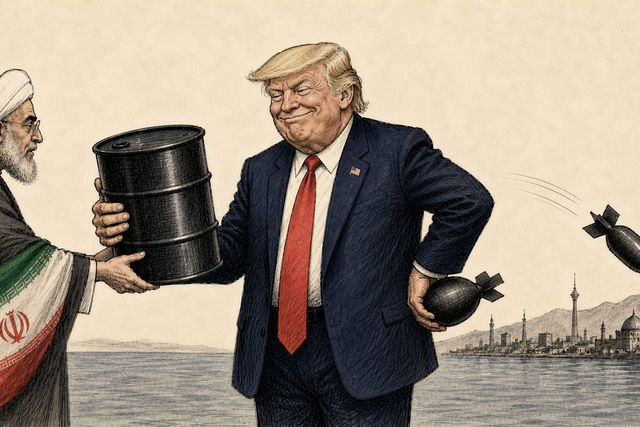
As you know, since Trump started the war in Iran, he is arguing that it’s not merely an American conflict, but a global conflict for which the allies in Europe step forward and join the United States.
And since then, one by one, America’s allies refused, making it clear they had no desire to be dragged into the fight.
Since then, his grievance has been simple: if they will not stand with the US when called upon, why should Washington continue guaranteeing their economic and military security?
This shift marks the very change in US foreign policy Trump signaled long before taking office for his second term.
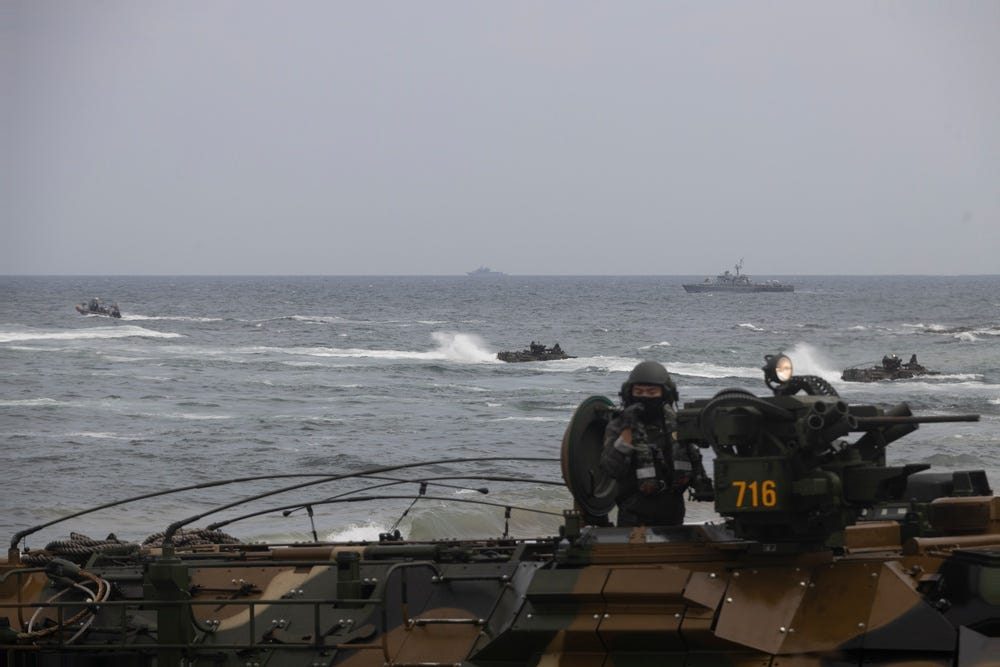
last month when Trump wrote that he had instructed his Secretary of War to “substantially reduce” joint military exercises with South Korea.
The stated reason was that the drills sent North Korea a signal that was “totally inappropriate and hostile.”
But buried in the same set of remarks was a second reason, and it had nothing to do with Pyongyang.
Seoul had declined to help the United States in its war against Iran.
One week later, on 24 August, the US Marine Corps cancelled Ssang Yong, the big biennial amphibious landing exercise with the South Korean Marines.
The reason given by Seoul’s marine spokesman, Han Seung-jeon, was
“constraints on force availability caused by the US-Israel war on Iran.”
And now in this week on 3 and 4 September — South Korean media reported that the government is preparing a military deployment to the Strait of Hormuz.
A maritime patrol aircraft, a logistics support vessel, or a mine clearance unit. A consent motion goes to parliament this month. The target is to have it done before the end of the year.
Three events, nineteen days, one country. Derek Davison’s world roundup that day noted the Seoul deployment and the Trump exercise cut in the same breath, and then moved on. Almost everyone did.
Read them together, and you are looking at something that has no name yet and badly needs one. The price of an American security guarantee has changed currency. It used to be paid in dollars. It is now being paid in deployments.
In this article, I want to trace exactly how that switch happened, why it happened now, and why the country that caved is the one you would least expect — because it is not the weakest ally on the list. It is the most protected one.
The list
Start on 15 March 2026, when Trump publicly asked other countries to send warships to reopen the Strait of Hormuz. He named them:
“Hopefully, Germany, France, Japan, South Korea, the UK, and others that are affected by this artificial constraint will send ships to the area…”
What happened next is the most instructive part of this whole story, and almost nobody wrote it down as a pattern.
Here is the scoreboard, one day later.
- Germany said no. Defence Minister Boris Pistorius: “This is not our war, we have not started it.”
- Luxembourg said no, and used the word. Deputy PM Xavier Bettel called the request “blackmail,” adding that Luxembourg would “be useful. But don’t ask us with troops and with machines.”
- Australia said no. Cabinet minister Catherine King: assistance was “not something that we’ve been asked or that we’re contributing to.”
- Japan said not yet. Prime Minister Sanae Takaichi said Tokyo had no plans for a naval deployment but was “continuing to examine what Japan can do independently.”
- China said no, loudly. Beijing called on all sides to “cease military actions.”
- Britain went halfway. Keir Starmer sent RAF jets and HMS Dragon, and avoided committing to the escort mission.
- France went all the way. Ten additional warships for commercial escort duty.
Now count the consequences. Germany refused and lost nothing. Australia refused and lost nothing. Japan stalled and lost nothing.
China was never going to say yes.
South Korea also declined, and five months later, its joint exercises were cut by presidential order, its amphibious exercise was cancelled, and it is now writing a deployment motion for parliament.
Why did the pressure land on Seoul and slide off Berlin?
Because Seoul is the one that has something to lose that Washington controls.
On thign is clear that the United States is running out of deployable force. the Pentagon confirmed that Defence Secretary Pete Hegseth has extended Middle East deployments into 2027.
Fifty thousand troops held in theatre. Elements of the 82nd Airborne are staying “well into 2027.” Fighter squadrons and warships extended with them. Eighteen American servicemembers killed so far.
This was supposed to be a short war.
It began in February 2026. It is now being planned around into a third calendar year, and the intelligence summaries this week describe the effect in one phrase: escalating strain on troops.
That strain is not abstract. It is why SsangYong was cancelled.
The Marines did not cancel a major allied exercise to make a political point about Iran. They cancelled it because they did not have the ships and the marines to run it.
So think about what that means for an alliance.
The superpower cannot simultaneously fight in the Gulf and reassure the Pacific. It must choose. And when a superpower has to choose, it starts asking the people it protects to cover the gap.
Not with money. Money is not the constraint.
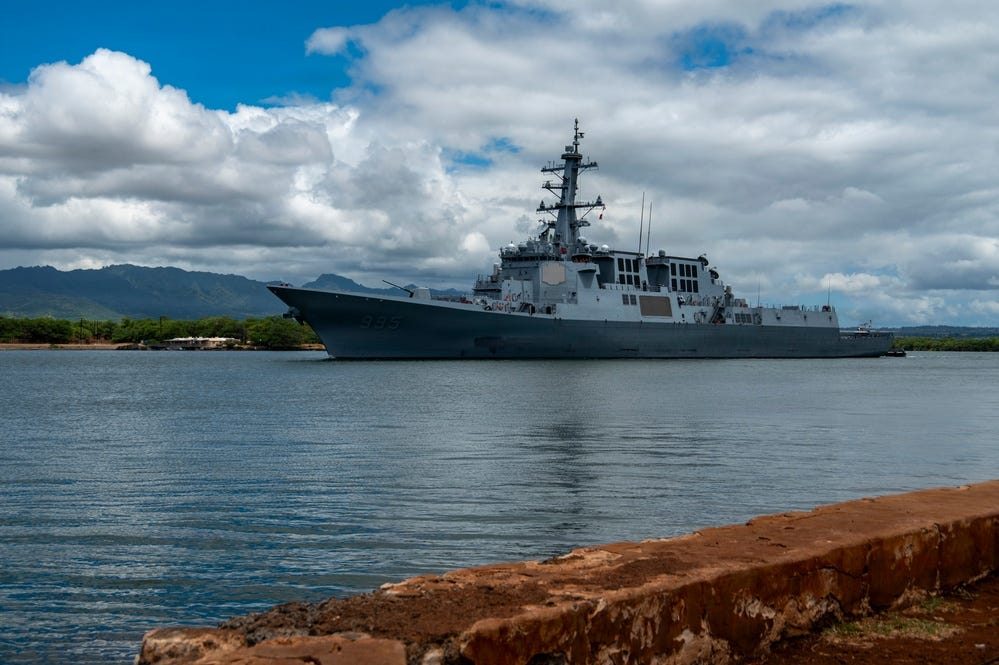
Look at the receipt, Seoul is already paying
South Korea is not a free rider, and this is where most commentary gets the story wrong.
Under the cost-sharing deal covering 2026 to 2030, Seoul pays 1.5192 trillion won — about $1.14 billion — for 2026, an 8.3% increase, with annual rises tied to its consumer price index and capped at 5%.
That is the bill for hosting 28,500 American troops. It is paid. It is not in dispute. It rises every year automatically.
And it bought Seoul precisely nothing in August.
That is the whole point. In the old model of alliance politics, the junior partner wrote a cheque and the senior partner supplied the security. Trump’s first term was an argument about the size of that cheque. This is a different argument. The cheque is agreed, and the security was withdrawn anyway.
Because what Washington is short of in 2026 is not cash. It is hulls, aircraft and people.
Brookings has a polite word for what is being asked instead: “modernisation.” In practice, it means strategic flexibility — American forces stationed in Korea being free to operate away from Korea, and Korean forces taking on jobs beyond the peninsula.
An alliance is being converted from a guarantee into a subscription with usage charges.
The therotical explanation
In 1991, the political scientist James Morrow published a paper in the American Journal of Political Science called “Alliances and Asymmetry.”
Its argument was simple enough to explain in one line, and it has governed how scholars read alliances ever since: in an unequal alliance, “one ally gains security and the other autonomy.”
The small state gets protection. The big state gets bases, positioning, and a partner that does not act independently.
Morrow tested it across 164 alliances between 1815 and 1965 and found the asymmetric ones lasted longer than the equal ones, precisely because each side wanted a different thing.
The weak state pays in freedom of action. That is the classic trade.
Now look at what is happening to South Korea and notice that the trade has quietly changed shape.
Like the there is a person, Isao Miyaoka flagged exactly this gap in Morrow’s model.
Post-war American alliances, he wrote, were never really about autonomy alone; Washington also required its junior partners to contribute real security capability.
What we are watching in 2026 is that the second demand is becoming the primary one. The autonomy has already been collected. Now the capability is being collected too.
And that is a different relationship. In the old bargain, the ally surrendered choices. In the new one, the ally supplies a force.
Korea has paid this exact tax twice before
Here is the part of the story that makes it predictable rather than shocking.
South Korea has been through this cycle before, and both times it was framed as something else.
In Iraq, Seoul deployed the Zaytun Division from September 2004 to December 2008, 3,600 soldiers based at Erbil, the third-largest foreign contingent in the country through 2005.
Officially, it was humanitarian: medical work, roads, power lines, schools. Nobody in Seoul or Washington pretended in private that the roads were the reason.
And in January 2020, under near-identical pressure, South Korea sent its Cheonghae unit into the Strait of Hormuz: one KDX-II destroyer and around 300 sailors.
Read how Seoul packaged that one, because the packaging is being reused right now. It was not a new deployment — it was an “expansion” of an existing anti-piracy mission. It would operate “independently,” not under the American-led coalition. It was justified by protecting 25,000 South Koreans in the Middle East and the shipping lanes carrying 70% of the country’s crude oil.
All of that was true. It was also happening while Washington was pressing Seoul to pay far more for those 28,000 American troops.
Six years later, the ships are different, and the script is identical. A patrol aircraft, a support vessel, a mine-clearance unit — technical, defensive, humanitarian-sounding, deniable.
The Blue House this week said reports of a settled deployment were “different from the facts,” while confirming it has been discussing “practical ways to contribute to freedom of navigation in the strait.”
That sentence is the tell. Governments do not draft consent motions for things they have not decided.
What an alliance is now worth
Every American ally is currently watching one experiment run in real time, and the result will price their own security for a decade.
The experiment is this: when the United States is overstretched, does the guarantee still hold for free?
So far, the answer coming back is that it holds for the countries that do not need it — France, Germany, Australia and it wobbles for the country that does.
The more American troops sit on your territory, the more leverage Washington has over you, and the more you will be asked to send your own people somewhere else.
That is an uncomfortable inversion. Protection was supposed to buy safety. It is starting to buy obligation.
And it is not an alliance decision. It is a hostage negotiation with good manners.
Alliances survive on the belief that the guarantee is unconditional — that is, the entire product. The moment allies work out that the guarantee has a running meter, they stop buying protection and start buying independence: their own missiles, their own submarines, in a few cases, their own bomb.
Washington is currently collecting a small, useful contribution to a war in the Gulf.