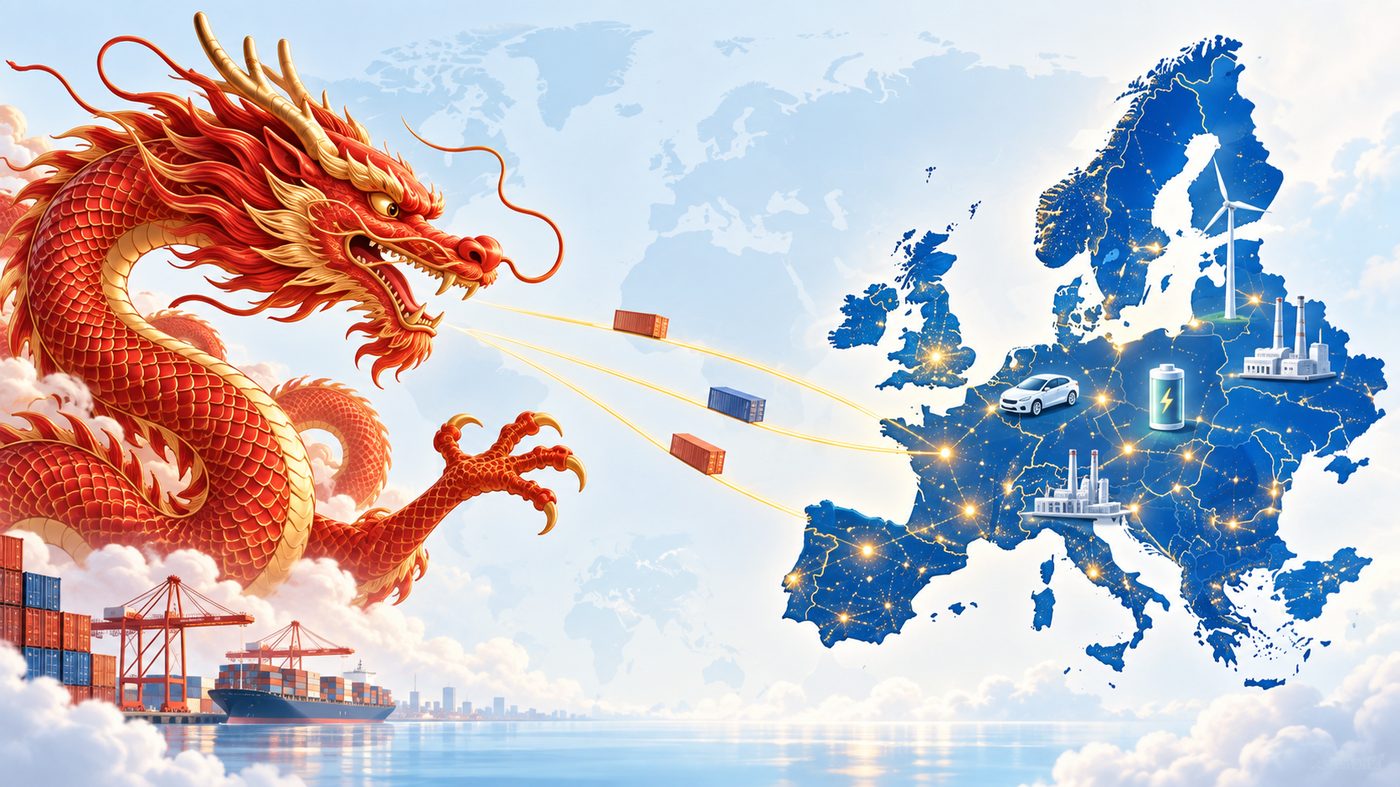
This is not something unique, but it’s the now the relatity that the EU is facing right now, and again, this phrase is not used by me at all, it's been used by the European news outlet
Take a look at the small thing
Inside the electric motor of a European car, there is a magnet. It weighs about 1 Kg. It costs a few euros. Without it, the car does not move.
Europe makes almost none of them. It buys 98 out of every 100 from China.
And since April 2025, to buy one, a European company has had to fill in a form for a government office in Beijing — naming its customers and explaining how it makes its products — and then wait to be told yes or no.
Last year, fewer than 15 out of every 100 of those forms came back approved.
In August 2025 alone, seven European production lines stopped because the answer was no. Forty-six more were expected to stop the following month.
Stop and think about what that sentence actually describes. A foreign government decides which European factories run and which ones stand still.
It is decided by issuing or refusing paperwork. And it has used that power, openly, to demand that Europe drop its tariffs on Chinese cars.
That is what a colony is.
A colony is an economy that produces what the centre needs, buys back what the centre makes, and cannot get the essentials without permission.
Europe in 2026 has every feature. Let me show you, number by number, and I will use only official sources — the European Commission’s own statistics office, the EU’s own auditors, the International Energy Agency, and the European industries’ own trade associations.
The gap is not a gap. It is the whole relationship.
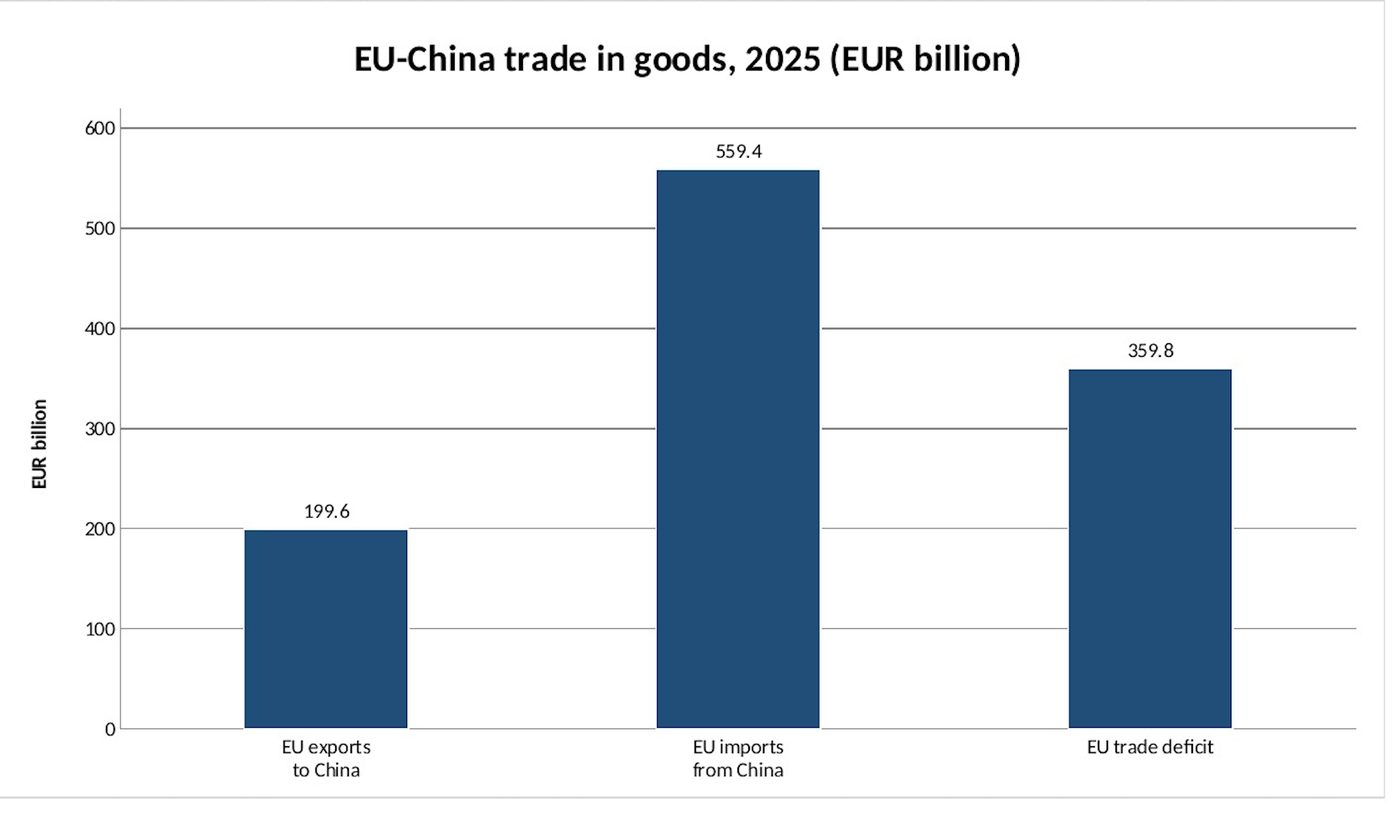
Eurostat is the official statistical office of the European Union. On 10 April 2026, it published the 2025 figures.
The official 2025 numbers, as published by Eurostat on 10 April 2026. Reproduced from the Eurostat release; figures and percentages are Eurostat’s own.
The EU exported €199.6 billion of goods to China and imported €559.4 billion. The deficit: €359.8 billion.
Read that once more. The deficit is nearly twice the size of everything Europe manages to sell.
And the direction is worse than the size. In 2024, EU exports to China fell 6.5%. Imports rose 6.4%.
Against 2015: exports up 37%, imports up 89%.
Europe is not slowly catching up. It is falling behind faster each year.
Now the most recent data. Eurostat’s live tracker, extracted in August 2026:
Eurostat’s latest EU-China trade update, data extracted August 2026. The sentences in quotation marks are reproduced word-for-word from the Eurostat page.
In its own words: “The EU trade in goods deficit with China in Q2 2026 (€103 billion) was the highest since Q3 2022.”
€103 billion in three months. Quarterly imports of €154 billion, up from €122 billion in early 2024.
Every single European policy designed to close this gap has been followed by the gap getting wider.
Now look at what is being traded, not how much
This is where “big deficit” turns into “colony”, and it is the part almost nobody explains.
A normal trade relationship between two rich economies looks like an exchange: you sell me machines, I sell you machines, we both specialise.
A colonial one looks different. The centre sells finished goods. The periphery sells inputs and slowly stops making the finished goods altogether.
Watch it happen in the one industry Europe is proudest of.
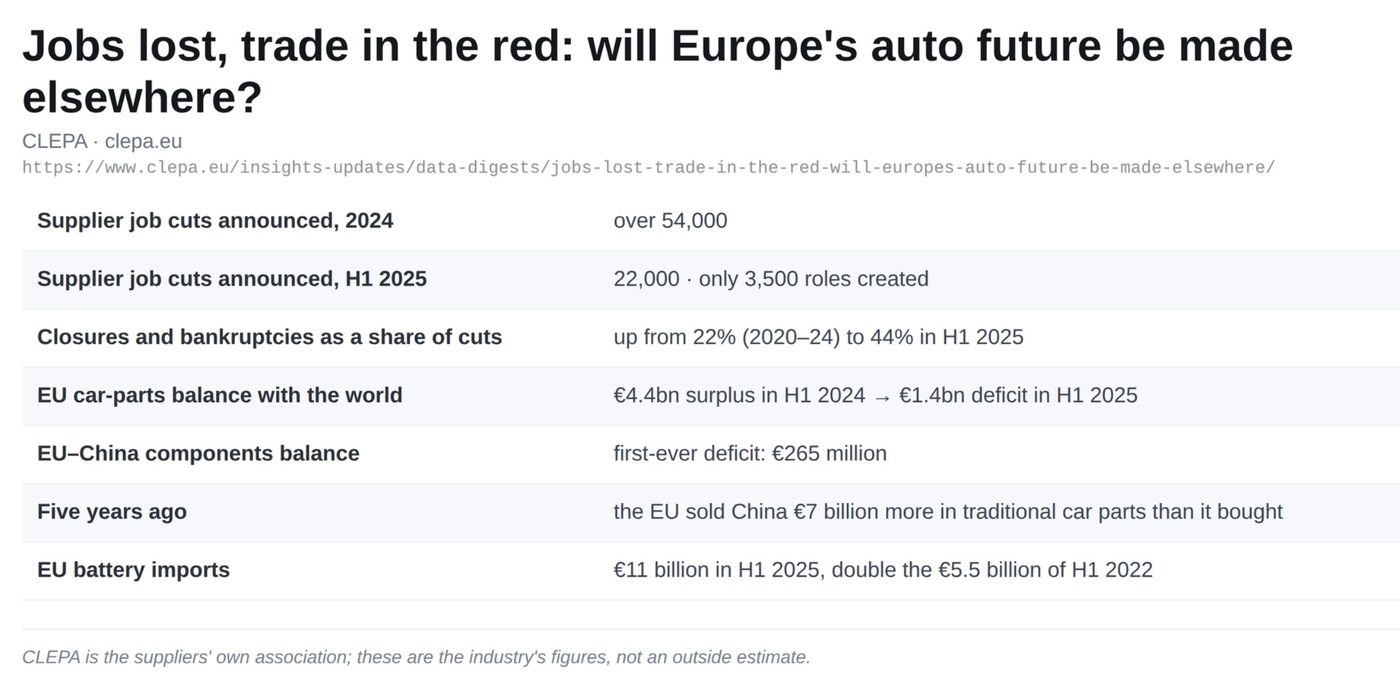
CLEPA is the European car suppliers’ own association — these are the companies’ own numbers, not an outsider’s estimate.
The European automotive suppliers’ association, reporting on its own members. Reproduced from CLEPA’s data digest of 4 September 2025.
Five years ago, the EU sold China €7 billion more in car components than it bought.
By the first half of 2025, that had flipped into a deficit — the first ever.
Across all car parts, an EU global surplus of €4.4 billion became a €1.4 billion deficit in twelve months. Battery imports doubled to €11 billion.
Europe used to sell China the parts. Now China sells Europe the parts. Next comes the car.
It already has. In the second quarter of 2026, Chinese carmakers took a record 10.7% of new car sales across Western Europe, nearly double the 5.7% of a year before. BYD alone outsold Tesla.
And notice how they are doing it. Geely has bought 34% of a Ford plant in Spain for €221 million. Leapmotor is deepening its tie-up with Stellantis.
The EU built a tariff wall. Chinese firms simply bought factories inside it.
The eight taps Beijing can turn off
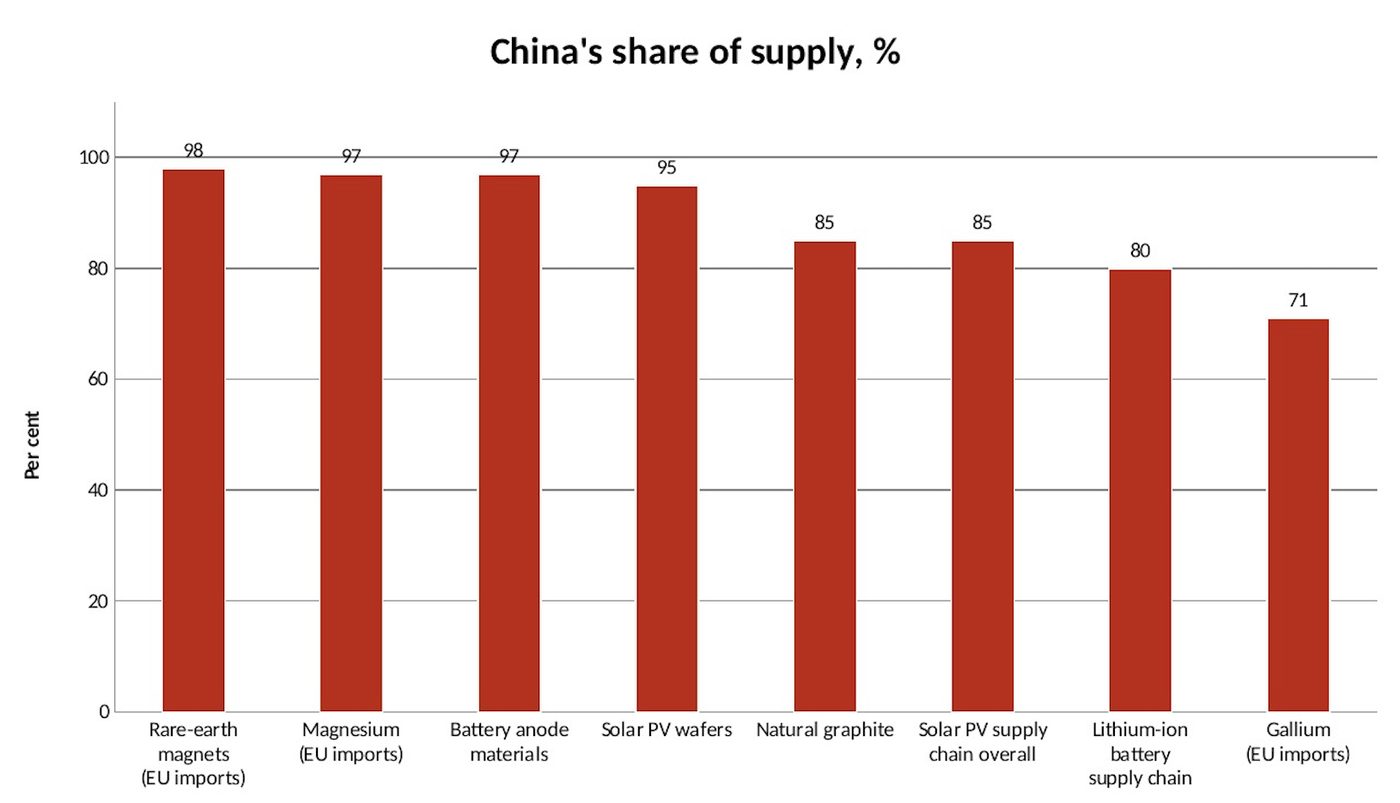
Just look at this data, it will show you how much Europe is dependent on China.
The European Court of Auditors’ February 2026 findings on EU dependence, as reported by Euronews. The ECA is the EU’s own external auditor.
China supplies 98% of the EU’s rare-earth magnets, 97% of its magnesium, 71% of its gallium, and controls roughly 90% of world refining capacity.
The auditor Keit Pentus-Rosimannus said it plainly: “Without critical raw materials, there will be no energy transition, no competitiveness, and no strategic autonomy.”
MERICS found the same on magnets: 98% of EU magnet imports, and Germany taking 95% of its rare earths from China.
Then add clean technology, from the International Energy Agency’s flagship report published in March 2026.
The IEA’s Energy Technology Perspectives 2026, published 26 March 2026. The final line is the IEA’s own modelled estimate.
China holds around 85% of solar PV supply chain capacity, 95% of wafers, 80% of the lithium-ion battery supply chain and 97% of anode materials, and refines over 70% of the world’s lithium, cobalt, graphite and rare earths.
And then the IEA gives one figure that should have ended the European debate on the spot.
If battery supply from the single largest Chinese supplier were interrupted, almost two-thirds of the resulting $17 billion in monthly output losses would land on European electric car manufacturing.
Two-thirds of a global shock. On one continent.
There is a single factory in Inner Mongolia, the IEA notes, that can produce the equivalent of the entire annual solar demand of the European Union and India combined.
A colony is not defined by who buys from whom. It is defined by who can be switched off, and who does the switching.
It has already been switched off. Twice.
People treat this as a warning about the future. It is not. Europe has already run the experiment and failed it twice.
The first test: the magnets.
The EU Institute for Security Studies, November 2025. EUISS is the European Union’s own security research agency.
Writing for the EU Institute for Security Studies — the Union’s own security think tank — Joris Teer recorded what happened after Beijing’s export controls came in: fewer than 15% of European licence applications were approved. Seven production stoppages in August 2025. Forty-six more are expected in September.
Beijing did not stop at slowing the material down. It used the approvals process to extract commercially sensitive information from European firms, and to push for the removal of EU trade measures on Chinese electric vehicles.
And on defence, Teer notes, “Beijing appears to continue to categorically deny licence requests from Europe’s defence manufacturers.”
Sit with that. Europe is rearming — €381 billion of defence spending in 2025, an €800 billion ReArm plan — using magnets it must ask Beijing’s permission to buy, and Beijing is refusing.
The second test: a chip worth pennies.
In autumn 2025 the Dutch government took control of the Chinese-owned chipmaker Nexperia on security grounds. Beijing’s response, on 4 October, was to bar Nexperia’s Chinese plant from exporting finished chips.
These are not advanced chips. They are the cheap ones — power control, sensors, window switches. BMW, Stellantis and Volkswagen all depend on them, and Europe’s carmakers’ association warned that “a critical shortage of foundational microchips is worsening by the day.”
Europe’s largest industry was brought to the edge of a standstill by a component worth a few cents.
Dependency, when it is called in, does not look like an army. It looks like a form that does not come back.
What it has already cost, counted in people
Now
The most important thing in this article for you how it’s impacting your job
The employment record from three separate sources: Germany’s federal statistics office via Clean Energy Wire, Automotive News Europe, and Chemistry & Industry.
Germany’s federal statistics office recorded that the German car industry lost 42,300 jobs in a single year, down 5.8%, to 691,500 people.
The reason given: a slow EV transition and “mounting competition from Chinese manufacturers offering cheaper EVs.”
Among suppliers, CLEPA counted 54,000 job cuts announced in 2024 and 22,000 more in the first half of 2025 — against 3,500 roles created. Automotive News Europe reported in March 2026 that the sector’s crisis now threatens 350,000 jobs.
Then chemicals, Europe’s second industrial pillar. Plant closures have risen sixfold since 2022. Thirty-seven million tonnes of capacity shut — about 9% of European capacity — and 20,000 direct jobs already gone, with industry bodies flagging 1 million direct and 10 million dependent jobs as exposed.
Sebastian Bray of Berenberg named the cause without hedging: “Overcapacity, stemming mainly from China, is the primary issue facing the European chemical sector right now.”
Steve Lewandowski of Chemical Market Analytics was blunter: “The industry is on the verge of collapse in Europe. The EU has not taken meaningful steps.”
By 2034, on current trends, almost half of the world’s polypropylene capacity will sit in China.
Why “colony” is the accurate word, not the angry one
A colonial economy has four features. This is economic history, not name-calling.
- The periphery buys back what it used to make. Europe’s car-parts surplus with China became a deficit in five years. Battery imports doubled in three.
- Local industry closes under competition from the centre. 42,300 German car jobs. 37 million tonnes of chemical capacity. 20,000 chemical jobs.
- The centre controls the essential inputs. 98% of magnets. 95% of solar wafers. 97% of anode material. Fewer than 15% of licences approved.
- The centre uses that control to change the periphery’s laws. Beijing tied magnet licences to the removal of EU tariffs on Chinese electric vehicles.
Point four is the one Brussels will not say out loud, and it is the only one that really matters.
A trade deficit is an economic problem. A supplier who can rewrite your legislation by refusing paperwork is a constitutional one.
There is a difference between a country that buys a lot from China and a country whose trade law can be vetoed by China’s Ministry of Commerce. Europe has quietly crossed from the first to the second.
And Europe’s answer to all this is… a deadline
On 27 August, in front of France’s largest employers’ federation, the President of the European Commission finally said the number out loud.
Ursula von der Leyen’s remarks to the Medef conference, 27 August 2026, as reported by Euronews.
Ursula von der Leyen told Medef that the EU’s trade deficit with China now runs at €1 billion a day, and that cheap Chinese imports have risen 45% in five years. She has given Beijing until October.
Now look at the two hands of cards.
Europe wants a smaller deficit, guaranteed rare-earth access, and market access for European firms. Its leverage: anti-dumping cases, steel safeguards with 50% out-of-quota tariffs, handling fees on Temu and Shein parcels, and an anti-coercion instrument it has never triggered.
China wants the EV tariffs gone and the Dutch restrictions on ASML lifted. Its leverage: it can stop European car factories inside six weeks. It has already instructed its companies not to cooperate with Commission investigations at all — on 19 August its Ministry of Justice declared that “no organisation or individual may execute or assist in the execution of such improper extraterritorial jurisdiction measures.”
EU officials flew to Beijing in late August for technical talks. A crisis task force under von der Leyen holds its first meeting this month, set up because the one-year rare-earth truce expires in October.
Bernd Lange, who chairs the European Parliament’s trade committee, has already called the deadline “not realistic at all.”
Von der Leyen has opened 30 trade defence investigations in a year, nearly triple the historical average. The deficit set a record anyway.
You cannot issue an ultimatum to your own supplier of last resort.
The truce lapses. Licensing tightens rather than stops, because Beijing is careful and does not need drama. Approval rates drift back toward last year’s 15%.
Within weeks: magnet shortages in motors, generators, sensors, actuators — and in the guidance systems of the weapons Europe is buying to defend itself.
Within a quarter: car lines idling, because requalifying a component takes months, and there is no alternative supplier to qualify.
Within two quarters, the jobs currently described as “at risk” stop being at risk and start being announced. The industries have already told us the size of that number, and it is measured in hundreds of thousands.
Meanwhile, the wind turbines do not get built, because the magnets are in them too. The solar panels do not get built, because 95% of the wafers come from one country. The batteries do not get built, because 97% of the anode material does.
Europe’s climate strategy, its industrial strategy and now its rearmament programme all run through a licensing desk in Beijing.
That is the sentence Brussels cannot bring itself to say, and it is why the October deadline is theatre.
Europe did not lose a trade war. It never fought one. It spent twenty years buying the cheapest available input, called the result efficiency, and only discovered at the end that efficiency and sovereignty come out of the same budget — and that it had spent the whole thing.
Colonies are rarely conquered. Mostly, they are bought: cheaply, gradually, and with the enthusiastic agreement of the people being bought.
Europe is not being invaded. It is being invoiced.